Columbia Card Task (CCT)
Figner, B., Mackinlay, R. J., Wilkening, F., & Weber, E. U. (2009). Affective and deliberative processes in risky choice: Age differences in risk taking in the Columbia Card Task. Journal of Experimental Psychology: Learning, Memory, and Cognition, 35(3), 709-730. doi: 10.1037/a0014983
|
For more information, contact
Bernd Figner
or
see
http://columbiacardtask.org.
Description:
Purpose
|
|
The CCT was designed to assess risk preferences, information use, and proximity to the optimal solution (as determined using a normative model) through choices made in a card game.
- There are two versions of the CCT. The "hot CCT" triggers strongly affective processes whereas the "cold CCT" elicits predominantly deliberative processes.
- The CCT is available in 2 formats: Internet-based online and locally running offline.
|
Questions
|
|
In either of the two versions of the CCT, participants play multiple trials in a card game. At the start of each trial, the participant is presented with 32 face-down cards. During the trial, Ps may turn over as many cards as they want.
- A gain card equals a specified positive amount and the chance to continue the trial.
- A loss card equals a specified subtraction from the previous payoff and ends the trial.
Trials vary in the following parameters, according to a factorial design:
- Probability of a loss (1-3 loss cards out of 32 cards total)
- Gain amount (10, 20, or 30 points per gain card)
- Loss amount (-250, -500, or -750 points from the previous payoff)
|
Sub-scales
|
|
There are 2 versions of the CCT:
- Hot: Stepwise incremental decisions (turn over one card at a time) with feedback after each decision.
- Cold: 1 decision of how many cards to turn over for the trial
|
Domain
|
|
|
Psychometrics
|
|
|
Sample items
|
|
Ps choose between:
- Turn over a card
- End trial
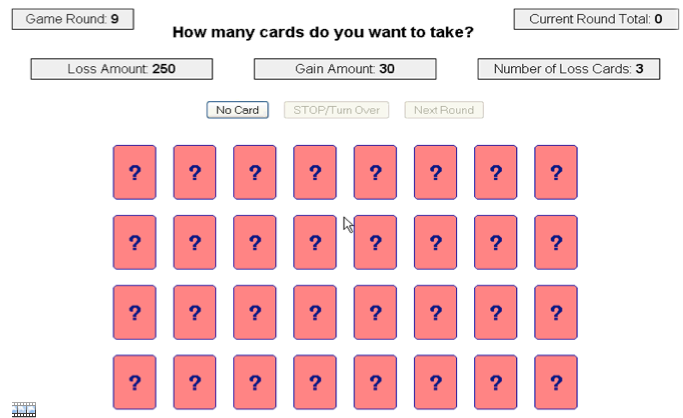 | | Screenshot of CCT. Source: Lisa Zavel |
|
References:
Scale:
- Figner, B., Mackinlay, R. J., Wilkening, F., & Weber, E. U. (2009). Affective and deliberative processes in risky choice: Age differences in risk taking in the Columbia Card Task. Journal of Experimental Psychology: Learning, Memory, and Cognition, 35(3), 709-730. doi: 10.1037/a0014983
|
Uses:
- Figner, B., & Murphy, R. O. (2011). Using skin conductance in judgment and decision making research. In M. Schulte-Mecklenbeck, A. Kuehberger, & R. Ranyard (Eds.), A handbook of process tracing methods for decision research (pp. 163-184). New York, NY: Psychology Press.
|
- Figner, B., & Weber, E. U. (in press). Who takes risk when and why? Determinants of risk-taking. Current Directions in Psychological Science.
|